MedMen Downsizes in a move to become fiscally viable in 2020
The article below is by Jonathan Cooper of www.SeekingAlpha.com. His assessment is based on his own research from public documents. Personally, as a former Director at MedMen, I am sorry to hear they are downsizing. MedMen has employed, curated, and developed tremendous talent. While at MedMen I accumulated tremendous knowledge and skills. It is difficult to find experienced cannabis executives and professionals. Many successful companies will bloom from former MedMen employees. Such as marijuana strart-up Plant Inspired Future aka P.I.F. The PIF website www.LivePif.com is well done. PIF has very good branding, lessons learned from MedMen. Other cannabis companies will gain tremendous talent from MedMen's ranks. MedMen has mastered branding, however, faltered with cash flow management and internal controls. MedMen has a tremendous Government Affairs team led by Morgan Sokol. The combination of Branding and Policy influence will keep MedMen in prime position, as long as they can fix their fiscal issues. MedMen has the best branding and name recognition in the ultra-large cannabis company category. MedMen needs to do some soul searching, and fix its past ills and mistakes. But they have the ability to survive and thrive if they can create better internal controls and management execution.
Landon Dais
Summary
MedMen runs great cannabis stores.
But extravagant spending has put the company in a deep financial hole, with about $223 million of debt.
MedMen has announced job cuts, asset sales, and is reducing expansion plans to try to stay afloat.
These moves are painful but necessary, although they may be too little, too late.
I will remain firmly on the sidelines.
Looking for a helping hand in the market? Members of The Growth Operation get exclusive ideas and guidance to navigate any climate. Get started today »
Source: TMX Money.
Summary
MedMen (OTCQB:MMNFF) is the top retail cannabis brand in the United States. Their marketing is second to none, including a terrific advertisement by Spike Jonze.
Unfortunately, MedMen's founders are less skilled at running a company than they are at marketing a hip cannabis brand. The company has been burning money for years. With cannabis stocks on a months-long decline, capital markets are becoming less willing to give MedMen more rope and debt is mounting. The company is now taking drastic steps to downsize: Reducing employee count, curtailing expansion, walking away from accretive-but-costly acquisitions, and even selling cannabis assets.
These efforts are necessary for survival. It remains to be seen whether they will be sufficient. MedMen is a very risky bet that an unproven management team and a first-time CFO can turn a money-losing, deeply-indebted company around before lenders own the top retail brand in cannabis and equity holders are left bag-holding until the end of the world.
I will stay firmly on the sidelines.
The Backdrop: Successful Stores; Terrible Cash Flow
Source: MedMen investor presentation.
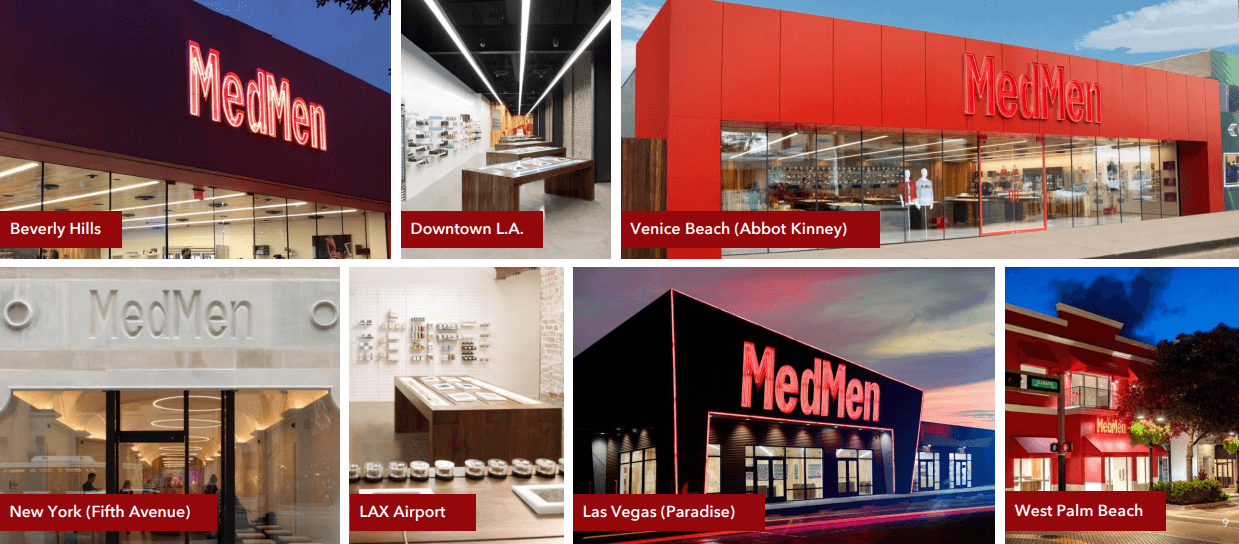
Successful stores: MedMen is a California-based and California-centered retail cannabis store chain. Their stores are most reminiscent of Apple stores with professional branding and design. These stores are very successful, with the company estimating their California cannabis shops sell about six times as much revenue as the average California pot shop.
Today, MedMen has 32 operating dispensaries nationwide, including 12 stores in California, eight stores in Florida, four stores in New York, and three stores in Nevada. Their California stores are their oldest and most successful, but MedMen's Nevada stores are also very lucrative and they are expanding aggressively in the Sunshine State's booming medical cannabis market.
Source: Author based on company filings. Results for the quarter ending September 28, 2019 will be released on November 26.
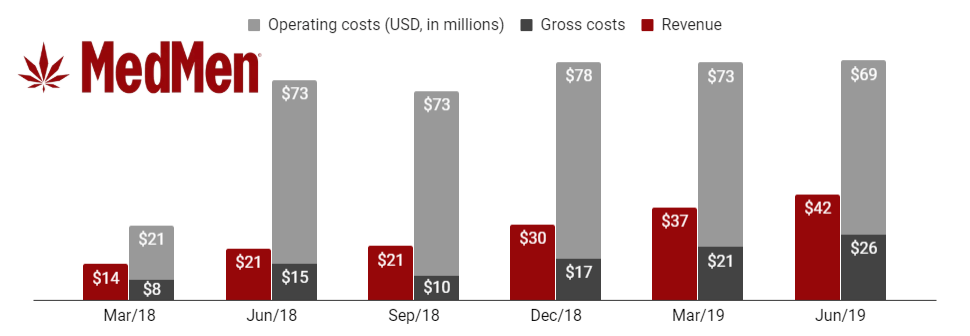
Terrible Cash Flow: While MedMen's individual stores are successful, high operating costs have impaired the company's ability to translate rising sales into rising profits and stock prices. Over the past five quarters, MedMen has spent a total of $365 million on operating costs while bringing in only $151 million in revenue. Even after two quarters of cuts to "corporate SG&A" (a subcategory of actual SG&A), MedMen's operating costs have declined only 11% and remain more than 1.5x their revenue.
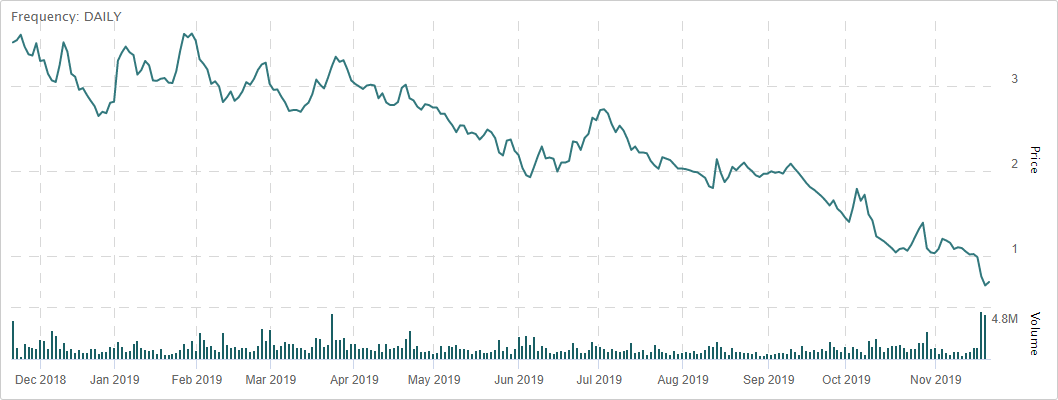
For a time, the market applauded this free spending "growth at all costs" attitude. MedMen's shares traded up to nearly $7 last October in the midst of investor enthusiasm over Canada's legalization of the popular intoxicant. Prices have declined 90% since those euphoric highs as debt mounts and profitability remains distant.
Source: Author based on company filings.
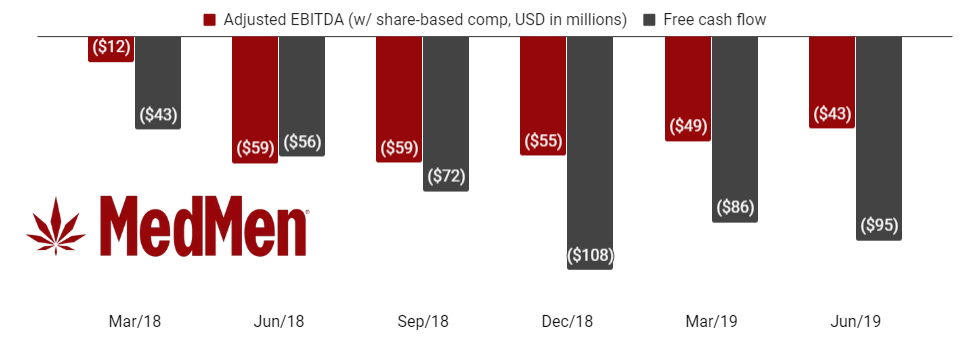
Over the past year, MedMen has burned $361 million in free cash flow. About one third of that cash burn is spent on expansion projects while the remaining two thirds is primarily due to high operating costs. The company also accumulated $205 million in adjusted EBITDA losses, once $32 million of dilution from share-based compensation is included. That figure also excludes $21 million in one-time costs.
The Consequences: Revolving-Door CFOs, Deep Debt, Abandoned Deals, Downsizing
During the enthusiastic gold rush into cannabis stocks, there were few consequences for burning cash. If anything, it was expected and perhaps necessary. But those days are firmly in the rear-view mirror and MedMen is beginning to see the consequences of its actions.
Revolving-Door CFOs: A position as MedMen's Chief Financial Officer has proven to be a revolving door job as MedMen is led by its founders CEO Adam Bierman and President Andrew Modlin. Last October, MedMen terminated their former CFO James Parker. He responded by filing a spicy lawsuit alleging co-founders Bierman and Modlin were breaching their fiduciary duties to shareholders, among other spicy allegations I described last February. Parker was replaced by an experienced CFO in Michael Kramer, who has held C-level executive roles at Apple Retail, Abercrombie & Fitch, JC Penney, and Forever 21.
As a seasoned executive, Kramer took control of MedMen and instituted cost cuts. He promised to cut "corporate SG&A" costs by 20% from December 2018 levels and co-founders Bierman and Modlin took pay cuts to $50,000 per year. While total SG&A has fallen only 11% from December, the "corporate SG&A" subcategory has fallen 15% (from $38.5 million down to $32.9 million) in the two quarters since that proclamation.
In October, MedMen terminated Michael Kramer as CFO. He was the second MedMen C-level executive to leave this year after the departure of COO Ben Cook and General Counsel Lisa Trager quit in April. Kramer was replaced by Zeeshan Hyder, who is a first-time CFO that has worked at MedMen for two years.
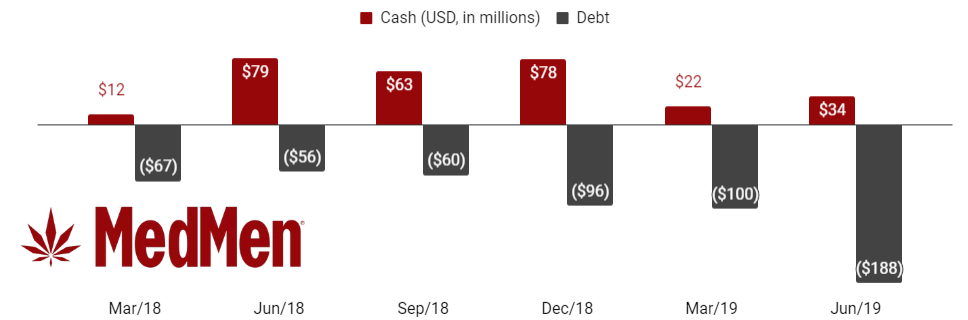
Source: Author based on company filings. MedMen raised money through their IPO in the June 2018 quarter.
Deep debt: MedMen ended their June quarter with $34 million in cash and $189 million in debt. To fund its spending, MedMen has turned to the debt markets. Gotham Green Partners ("GGP"), co-founded by Cronos (CRON) CEO Michael Gorenstein, has been their most prominent lender.
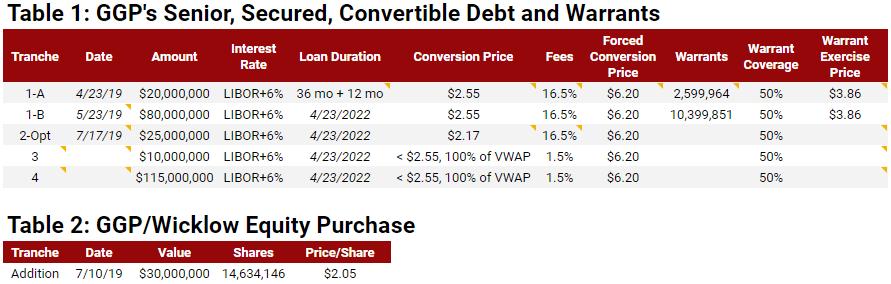
Source: Author based on MedMen press releases. Some details are unknown or estimated, such as the number of warrants and their strike price for the second (optional) tranche.
MedMen first announced a $250 million senior, secured, convertible loan from GGP in March. GGP's debt is senior, secured, and convertible - giving GGP upside if MedMen does well and more power if MedMen goes bankrupt.
This credit facility has been subsequently amended/updated several times, including press release in April, May, July, August, and October. Among other changes to the facility, the amendments increased the deal size to $280 million, reduced the conversion price of the convertible debt, allowed MedMen to receive the funds sooner, charged MedMen a 15% fee (~$19 million) which is forgiven in certain circumstances, and forced MedMen to appoint an independent board of directors.
The latter change is potentially the most important.
"In addition, the Company has agreed to form a committee to select new independent directors to be appointed or elected to the board, which directors would form a majority of the board. The Company will propose director candidates to this committee for consideration and approval."
This innocuous sentence may signal a major power shift at MedMen.
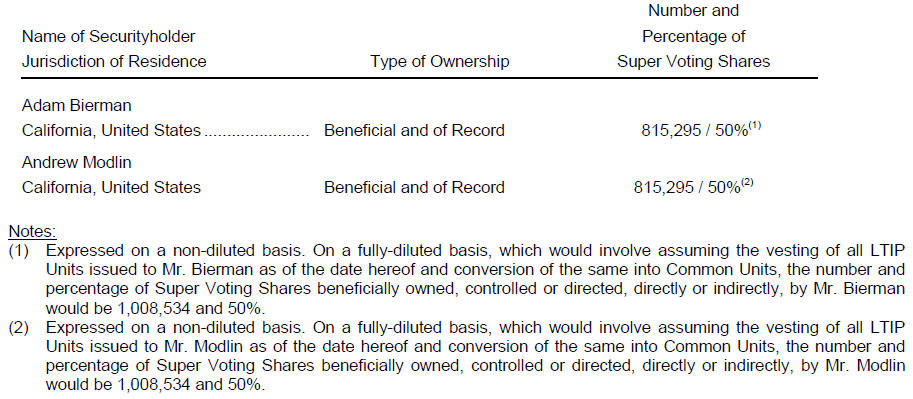
Source: MedMen fiilng statement, May 2018.
Until now, MedMen has been controlled by co-founders Bierman and Modlin. Both sit on MedMen's board and they hold voting control through their 1.6 million super voting shares which command 1,000 votes per share. At the time of MedMen's IPO last year, those shares controlled 98.3% of MedMen voting rights: Bierman and Modlin chose the board of directors. After their most recent financing round, a committee has the ultimate right to consider and approve directors.
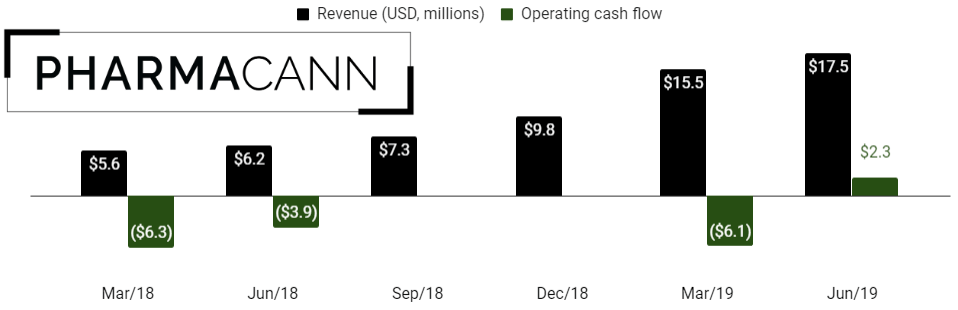
Source: Author based on MedMen filings.
Abandoned deals: Because of their faltering cash position and declining stock price, MedMen walked away from the accretive acquisition of PharmaCann. In the June quarter, PharmaCann was EBITDA-profitable and produced positive operating cash flow - two feats MedMen has never accomplished.
MedMen management suggest they chose to walk away from this all-stock deal in order to preserve their capital and to focus on California. In exchange for the settlement of a loan to PharmaCann, MedMen received assets in Illinois and Virginia including a retail location in Evanston, IL, and a recreational cannabis retail license in Greater Chicago.
Source: Variety, courtesy of Paramount Pictures.
Downsizing: MedMen announced its most drastic cuts yet last week. Among other changes, the company is:
- Laying off 190 employees: MedMen cut 190 jobs including 90 corporate-level employees. The company hopes to save $10 million in annual savings through this move. Ultimately, they hope to bring "corporate SG&A" spending down to $85 million annually by mid-2020. (They spent $33 million on "corporate SG&A" last quarter.) They also are flattening their corporate organization and consolidating their corporate offices into a single Los Angeles campus.
- Selling cannabis assets: MedMen is selling its stake in the cannabis-focused Treehouse REIT for $14 million. They also hired Canaccord Genuity to help them sell cannabis licenses in "non-core" markets. They also are selling minority investments in high-growth cannabis brands for $8 million.
- Cutting expansion plans: MedMen is limiting its store openings to what it sees as the highest-value markets, including delaying investments into New York and into Arizona. MedMen has delayed at least $55 million of capital expenditures and will slow down their M&A plans and renegotiate a previously agreed $15 million cash earn-out payment from a previous deal.
- Cutting costs: MedMen will reduce marketing and technology spending to save $20 million annually. They also will save $2 million annually by re-negotiating insurance rates and outsourcing human resources.
- Renegotiating with suppliers: MedMen is renegotiating its deals with suppliers in California. These deals will aim for a minimum of 60% gross margins for MedMen.
MedMen is aiming to generate positive adjusted EBITDA by the end of 2020. Last quarter, the company lost $39.4 million in adjusted EBITDA, excluding $14.6 million in share-based compensation and one-time costs.
These changes are going to cut costs but will come at the expense of reduced growth: Selling cannabis assets will reduce MedMen's built-out footprint and revenue potential. Decreased investments in expansions and retail openings will cut into revenue growth as well.
Thoughts
MedMen's cuts are long overdue.
After Tranche 3 issues in November, MedMen will have approximately $223 million in debt. If they can hit their EBITDA target, they will become adjusted EBITDA-profitable in late 2020. Free cash flow is a more difficult profitability target, however, so it is likely the MedMen will continue to rely on outside funding into 2021.
Outside funding is growing increasingly difficult to find. In Canada, The Green Organic Dutchman (OTCQX:TGODF) had to drastically downsize their build-out goals based on the difficult of finding financing while Aurora Cannabis (ACB) has had to resort to painful "death spiral"-like financing to pay down their debt coming due. If MedMen is unable to bring their spending and debt under control, they may suffer those fates or worse.
Thus far, Gotham Green Partners has been willing to throw MedMen enough rope to keep them afloat. But their generosity and patience are not unlimited, and the senior and secured nature of GGP's lending gives the company far more rights than common shareholders if MedMen defaults on their debts. Without spending cuts, creditors can turn into owners with equity holders grasping onto worthless paper.
MedMen is not there yet, however. They are fighting to survive and spending cuts are a great start. But the company is starting from a deep hole and I will remain firmly on the sidelines while this plays out.
Happy investing!
Make better cannabis investments with better information
The Growth Operation is the largest community of cannabis investors on Seeking Alpha. I post in-depth analysis of under-covered cannabis companies, focusing on fundamental analysis and future profitability and cash flow, and daily cannabis news to help investors keep up-to-date. We also have a lively chat room to discuss ideas with other investors.
Among other live data features, I recently added detailed weekly charts illustrating cannabis sales in Florida and Illinois, shown below, to help investors make more informed investment decisions.
Comments
Post a Comment